Whole-House Repiping
Whole-house repiping replaces every hot and cold supply line from the main shutoff to each fixture.
See the servicePipes, leaks and water lines
Banging pipes, a toilet that keeps refilling and faucets that blast when opened often trace back to one valve. When the pressure regulator fails, we test, replace it and set the house to a safe pressure.
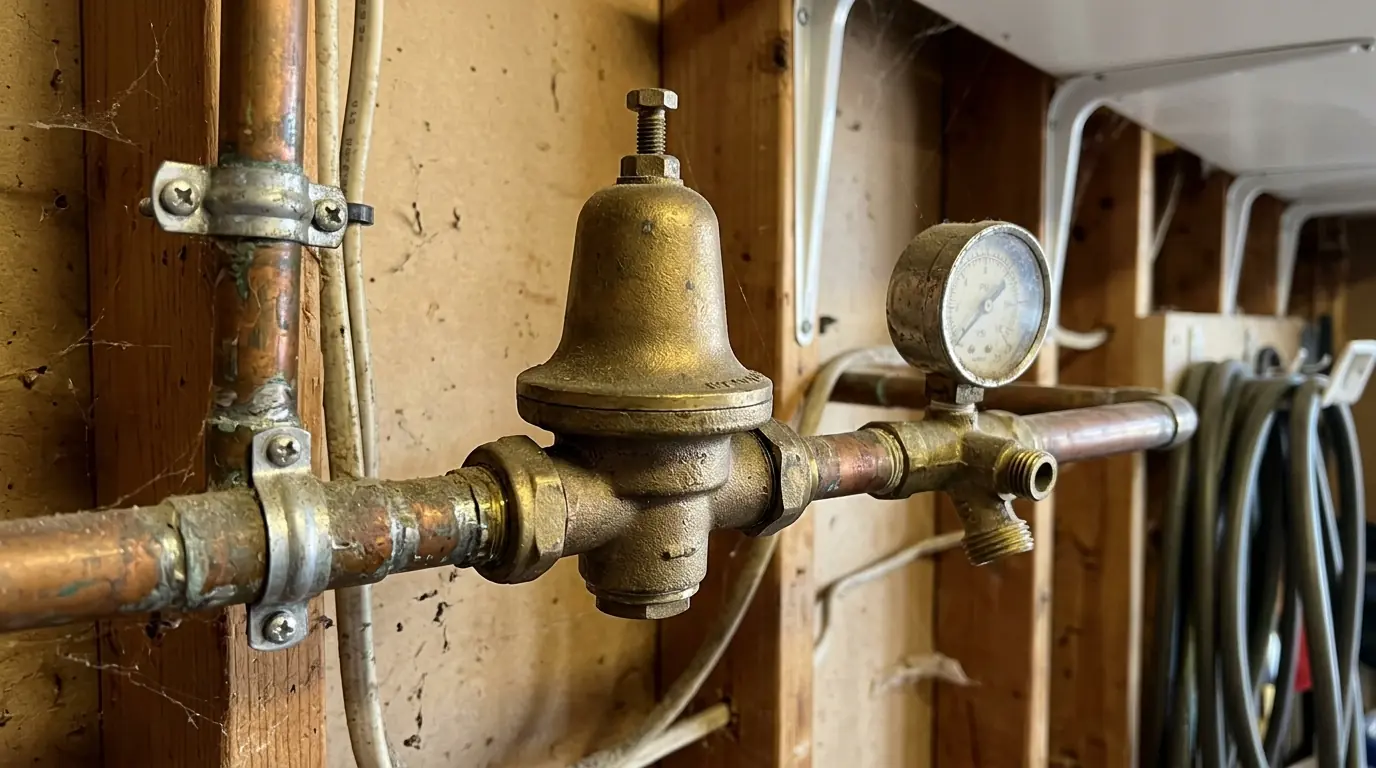
A pressure regulator, or pressure reducing valve, sits on the main water line and lowers street pressure to a level your plumbing can handle. Replacement means testing the house pressure, removing the failed valve, installing a new one with unions, and setting it to the right range. You need it when pressure tests high, swings up and down, or drops to a trickle.
City water pressure varies across Salem with elevation. Homes low in the valley may see moderate pressure at the meter, while houses in the South Salem and West Salem hills can receive much more, because the system has to push water uphill to reach higher neighborhoods. A pressure reducing valve evens that out for the house.
These valves wear out. Their internal diaphragm and seat age, and the valve begins to let more pressure through than it should, or it sticks and starves the house. Either way, the symptoms show up all over the house at once, which is a good clue that the problem is at the main and not at one fixture.
The valve has a spring pressing on a diaphragm. Street pressure pushes against one side, and the spring holds a seat partly open on the other. When you open a faucet, house pressure drops, the spring opens the seat a little wider, and water flows until pressure recovers.
An adjusting screw on top sets the spring tension, which sets the house pressure. Over years, mineral buildup, a tired spring or a torn diaphragm keeps the seat from closing properly. That is when house pressure starts creeping up toward street pressure, often overnight when nothing is running.
Most homes run well between about 50 and 70 psi. Plumbing codes commonly call for a regulator once street pressure goes above 80 psi, because sustained high pressure shortens the life of everything connected to the system. The damage is gradual, so it often gets blamed on fixtures instead of the pressure.
A working regulator acts like a one-way door, so water heated in your tank cannot push back into the city main. As the water warms and expands, house pressure rises with nowhere to go. That spike can open the water heater's relief valve or stress fittings throughout the house.
An expansion tank gives that extra volume a place to go. It is a small tank with an air cushion behind a rubber bladder, mounted near the water heater. When we replace a regulator, we check for an expansion tank and test its air charge, since a failed tank can mimic a bad valve.
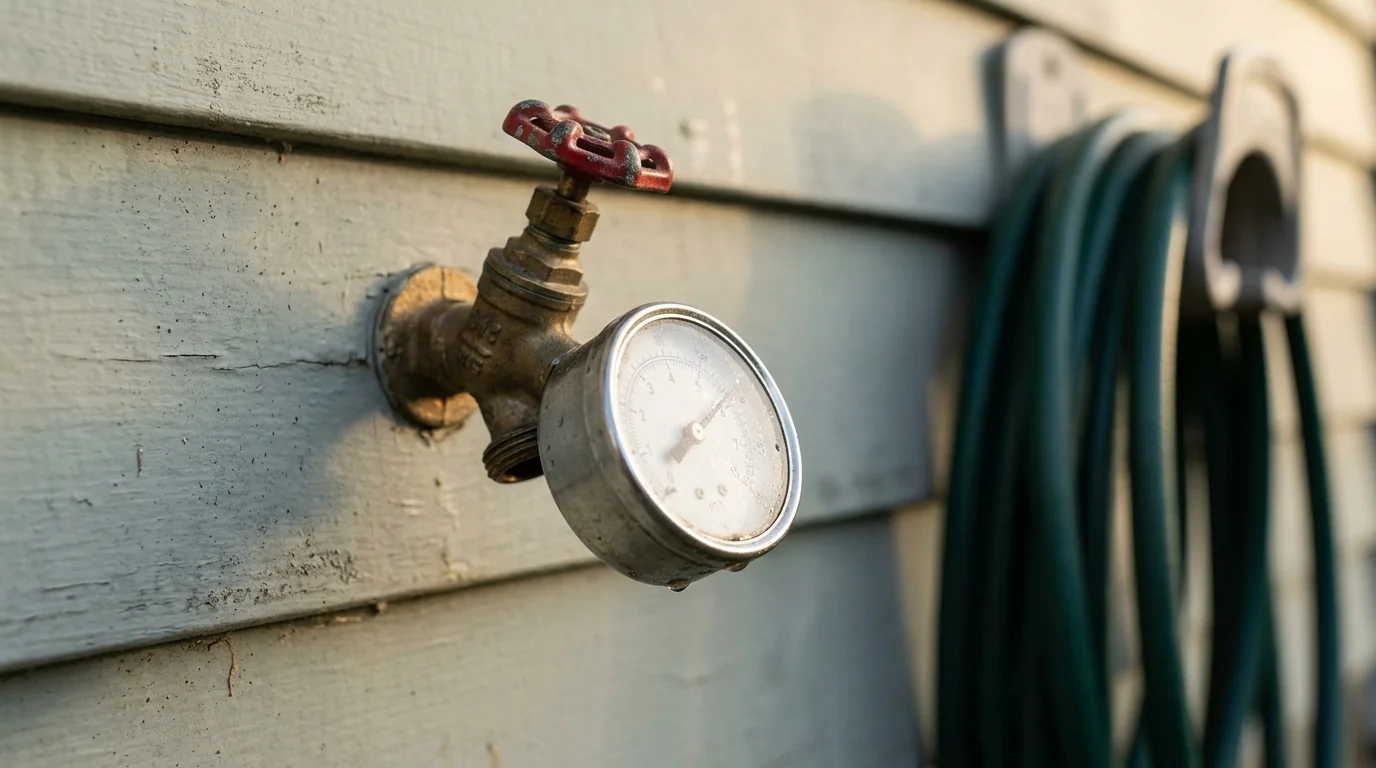
We thread a gauge onto an outdoor faucet or the water heater drain and read static pressure with nothing running. A second reading the next morning, or a gauge with a tattletale needle left overnight, catches pressure that climbs while the house sleeps.
After the new valve is installed, we set it, open several fixtures to watch how it holds under flow, then close them and confirm it settles back where it should. You get the readings so you know the starting point for future checks.
Warning signs
On the visit
We attach a gauge at an outdoor faucet or the water heater and record static and flowing pressure.
The plumber tests the expansion tank's air charge and looks for a waterlogged or missing tank.
Water is shut off, the old valve comes out, and a new regulator is installed with unions for future service.
We adjust the new valve to a sensible house pressure and confirm it holds under flow and at rest.
Toilets, the water heater relief valve and faucets are checked for leaks or damage left by past high pressure.
| What is included | Typical range |
|---|---|
| Pressure regulator replacement, installed and set | $389 to $849 |
| Thermal expansion tank installed at the water heater | $279 to $545 |
| Pressure test only with gauge readings | $95 to $165 |
Valve size, location and the condition of nearby pipe affect the price. The final price is given before work starts, once the plumber has tested your pressure.
Around Salem
Regulator calls come mostly from the South Salem hills around Sunnyslope, Faye Wright and South Gateway and from the West Salem hills, where uphill delivery brings high street pressure into 1970s to 2000s homes.
Prices for every service are on one page: the First Choice Rooter price list.
Call (971) 326-9414Questions
Buy an inexpensive gauge that threads onto a hose bib and read it with nothing running in the house. If it reads above 80 psi, a regulator is generally needed. If you already have one and the reading is high, the valve is likely failing. Readings that climb overnight point to thermal expansion or a regulator that no longer seals.
It is usually on the main supply line just after it enters the house, often in the crawlspace near the front foundation wall, in the garage, or close to the main shutoff. Some homes have it outside near the meter in its own box. It is a bell-shaped brass valve with an adjusting screw and lock nut on top.
If the valve is in good condition and simply set too high, turning the adjusting screw can bring pressure down. If the pressure keeps creeping back up, swings during the day or will not respond to adjustment, the internal parts have worn and replacing the valve is the lasting fix. Most regulators last somewhere around 10 to 15 years.
The new valve may be set lower than the old one had drifted to, so the house feels weaker even though it is now in a normal range. A clogged inlet screen on the regulator can also cut flow. We can raise the setting within a safe range or clean the screen, and we check that flow holds when several fixtures run at once.
When a regulator turns your system into a closed one, many codes call for thermal expansion control at the water heater, and an expansion tank is the usual answer. If you already have a tank, we test its air charge. If you do not, we explain why one helps and give you the price as a separate line.
Related work
Whole-house repiping replaces every hot and cold supply line from the main shutoff to each fixture.
See the serviceWater heater repair means finding why a tank has stopped heating properly and fixing that part instead of replacing the whole heater.
See the serviceToilet repair means replacing or adjusting the parts inside the tank and under the bowl: the fill valve, flapper, flush valve, handle, supply line and the seal at.
See the serviceA real person answers 24/7. Tell us what the drains are doing and we will send a First Choice Rooter plumber with the right equipment on the truck.