Sewer Camera Inspection
A sewer camera inspection is a video trip through the pipe that carries waste from your house to the public main.
See the servicePipes, leaks and water lines
Old cast-iron drains rust from the inside, narrowing until they clog again and again, then rot through along the bottom and drip into the crawlspace. We cut out the failing pipe and replace it with ABS or PVC.
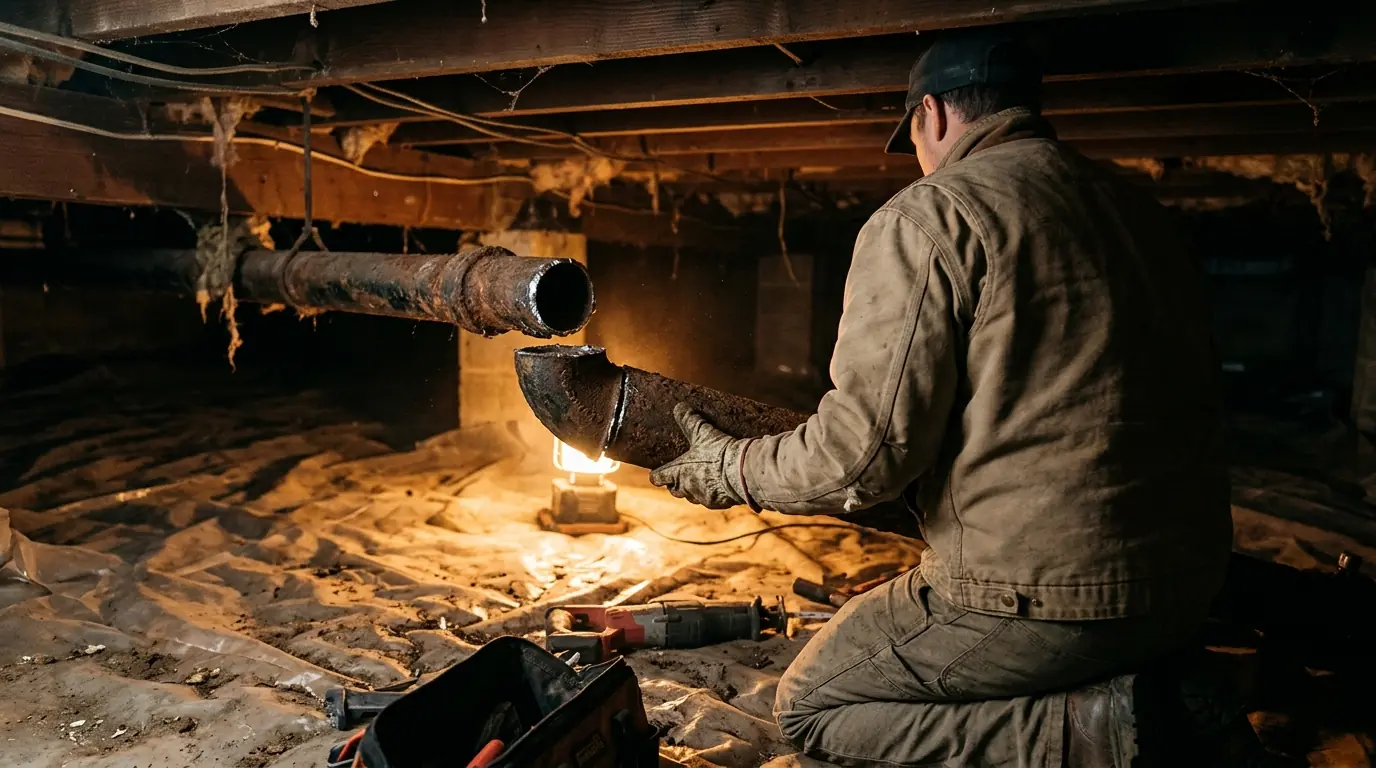
Cast iron drain replacement means removing sections of the original iron drain and vent pipe and installing plastic pipe in their place, joined to the remaining iron with no-hub couplings. You need it when a camera or a close look shows channel rot, cracks, heavy scale or active leaks, or when the same line keeps clogging after cleaning because the bore has closed down.
Many Salem houses built between the early 1900s and the 1960s still drain through their original cast iron. It has held up well, but every year of wastewater leaves more rust and scale on the inside wall. Eventually a pipe that was four inches across behaves like a much smaller one, and paper and grease catch on the rough crust.
Replacement does not have to mean tearing the whole house apart. In most homes we start with the worst section, usually a horizontal run in the crawlspace, and leave sound pipe in service. We tell you what we found, what can wait and what cannot, and we plan the work so you can keep using at least one bathroom for most of the job.
Wastewater and the gases that come off it attack iron slowly. In a horizontal pipe the bottom stays wet the longest, so that is where the metal thins first. Over decades a groove forms along the floor of the pipe, then the groove opens into a slot that lets water drip onto the crawlspace soil.
The top of the same pipe can look solid from outside, which is why tapping on it or a quick glance is not enough. A camera run down the line shows the channel, the rough scale and any spots where the iron has already opened up.
Cast iron is heavy, so before we cut, the plumber supports the pipe above and below the section with riser clamps or straps. We cut with a snap cutter or a saw, lower the old piece out carefully, and dry-fit the new ABS or PVC run with the right slope back toward the main line.
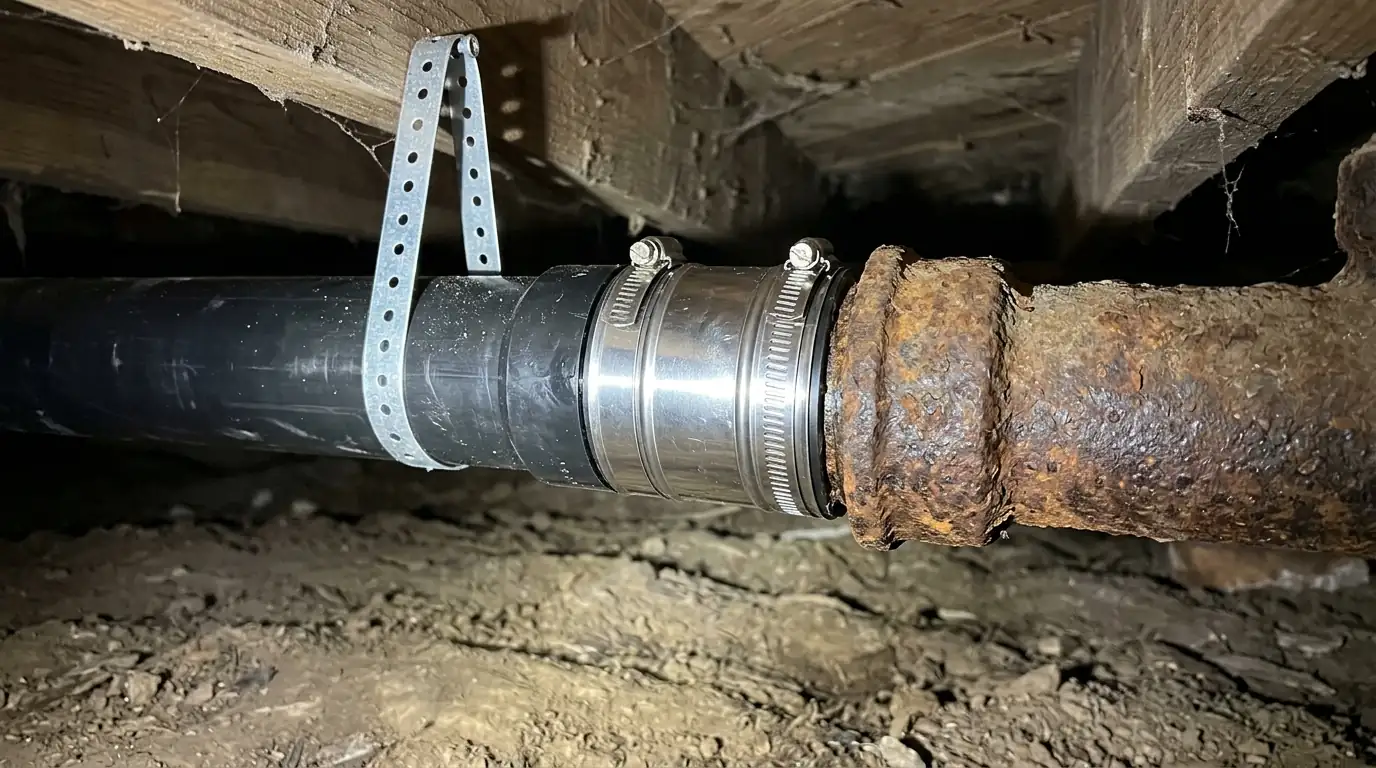
Where new plastic meets iron that stays, we use shielded no-hub couplings sized for that transition. The new run gets proper hangers so it holds its slope, and every joint is tested with water before the crawlspace is closed back up. When a permit is required, we pull it.
If the camera shows one bad run and the rest of the pipe still has good walls, a section replacement makes sense and costs far less. If the main stack is cracked, several runs show channel rot, or the iron under the floor is scaled almost shut, piecing it together usually just moves the next leak a few feet over.
We show you the footage and point out the difference between surface rust and pipe that has lost its wall. You decide with the facts in front of you, and we can stage a larger job over more than one visit if that suits your budget.
Nobody wants to go a week without a toilet. For a section job, the drain is usually out of service for part of one day. For a full stack or a long under-floor run, we work in stages, cap open lines at the end of each day and keep at least one toilet and sink working whenever the layout allows.
We tell you ahead of time which fixtures will be off and for roughly how long. Holding off on laundry and dishwasher loads during the work window helps a lot, because those machines dump a lot of water at once.
Warning signs
On the visit
We run a camera through the iron drain and look at the outside of the pipe in the crawlspace to map rot, scale and cracks.
You see the footage, we mark the sections that need replacing, and the plumber gives you the final price before any pipe is cut.
The iron above and below the work area is clamped or strapped, then the failing section is cut and lowered out carefully.
New ABS or PVC goes in with correct slope and hangers, joined to the remaining iron with shielded no-hub couplings.
We run water through every new joint, check for leaks from below, haul away the old iron and leave the crawlspace tidy.
| What is included | Typical range |
|---|---|
| Section of cast-iron drain replaced with ABS or PVC | $890 to $3,400 |
| Full stack or under-floor run replaced | $3,900 to $11,800 |
| Extra no-hub transition at a second branch line | $165 to $340 |
| Wall opening along a stack, left ready for patching | $140 to $385 |
Price depends on how much pipe is replaced, how tight the crawlspace is and whether walls must be opened. The plumber gives you the final price before work starts, after seeing the job.
Around Salem
We replace cast iron most often in Grant, Highland, Englewood, Fairmount Hill and the Gaiety Hill area, where homes from the early 1900s to the 1940s still drain through original iron in damp crawlspaces.
Prices for every service are on one page: the First Choice Rooter price list.
Call (971) 326-9414Questions
Many last 50 to 100 years, and some original pipe from the 1920s is still working. Life depends on use, harsh drain chemicals and damp crawlspace air. Horizontal runs almost always fail before vertical stacks because their bottoms stay wet the longest.
Yes, and that is often the right first move. If the camera shows one rotted run and the iron on either side still has solid walls, we replace that section and join it to the old pipe with no-hub couplings. We will tell you plainly if the remaining iron looks close to the same point, so you can plan for it.
Both are standard materials for home drain and vent lines. ABS is very common in Oregon houses and joins with a one-step cement, while PVC comes in a wider range of fittings. Plastic carries more flushing noise than iron does, so on a stack inside a bedroom wall we can wrap the new pipe to quiet it.
Most under-floor work happens from the crawlspace, so floors stay untouched. Vertical stacks inside walls are the exception: we open drywall or plaster along the stack, and on some jobs we can reach the pipe from a closet or the back of a cabinet instead. We point out any openings before work begins.
Cleaning can buy time. A descaling head on a cable machine knocks the worst rust crust off the inside wall and restores some flow. It cannot rebuild metal that has already worn away, though, and on pipe with channel rot an aggressive descaling pass can open a weak spot. We look with a camera first to choose the right approach.
Related work
A sewer camera inspection is a video trip through the pipe that carries waste from your house to the public main.
See the serviceCrawlspace plumbing repair covers the supply lines, drain and vent piping, and shutoffs that run beneath a raised floor.
See the serviceSewer line repair, often called a spot or point repair, replaces a short damaged section of your lateral instead of the entire run.
See the serviceA real person answers 24/7. Tell us what the drains are doing and we will send a First Choice Rooter plumber with the right equipment on the truck.